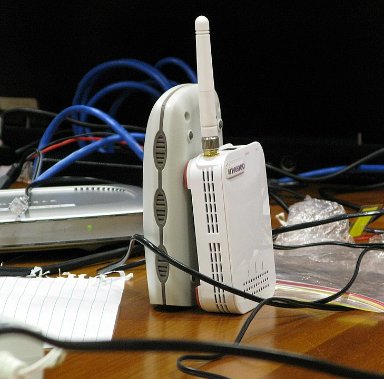
The Mesh Potato is a concept developed at the Village Telco workshop (June 16-20, 2008) at the Shuttleworth Foundation. The objective of the workshop was to try to develop a prototype of the Village Telco as well as to develop the business model. The discussion around the business model led to an interesting exploration of what are the critical scale-up costs for a Village Telco. Two key factors emerged 1) power and 2) handsets.
Handsets prove to be a particular challenge for a couple of reasons. An initial assumption for the Village Telco was that low-cost VOIP handsets would probably be the most viable, convenient way of delivering telephones to customers. While the cost of VOIP phones appear to be steadily descreasing and the convenience of a handheld, battery powered device is very attractive, the small antenna is a signficant problem for a Village Telco. Even when you have access points that cover up to a two kilometre radius, wireless VOIP phones would need to be no more than 100 metres away for a reliable connection. This significantly drives up the number of wireless access points that would be required to cover a given area, signficantly driving up the overall startup cost.
In order to keep the number of access points down, the antenna for each user’s phone would have to be stronger. Another possibility would be to use a small mesh device like the Open Mesh AP and connect a SIP phone to the AP. This would solve the antenna problem and also increase the coverage area as each phone would also be a mesh node. Unfortunately this is still a comparatively expensive option.
 As we were debating the options, Rael Lissoos grabbed an ATA (Analog Telephone Adaptor) and an OpenMesh AP and held them together and said, what we need is these two devices in one. And thus the idea for a Mesh Potato was born. The name Mesh Potato came from combining Mesh with POTS (Plain Old Telephone Service) and ATA. Patata is Spanish for potato and Alberto Escudero-Pascual made the link…. The Mesh Potato…. a Mesh enabled WiFi device with an RJ11 port to connect an inexpensive regular phone and an RJ45 to connect any IP device.
The device would be based on the Atheros chipset used by Meraki and OpenMesh and would run OpenWRT and BATMAN. Asterisk would deliver the telephony function. Designed with a weatherproof housing, this device could be attached to the outside of a house or would even work inside if need be. Pre-configured, it would be plug and play for a new Village Telco client.
Now, had Open Hardware maverick, David Rowe, not been at the workshop, this might have been idle speculation on a “love-to-see” technology. As it turned out, David said “I could do that….”. I don’t think we all took him completely seriously at first but as the conversation ensued, it appears that bringing together the right designers, developers, and manufacturers was eminently possible. The more we discussed it, the more excited we all became that we might be able to drive our own hardware design in stead of depending on the luck of the market to come up with technology that could be appropriated for developing countries.
So, we are building it. The Shuttleworth Foundation is backing the initial development of the hardware design and firmware development. We are currently testing prototypes and expect to have a full production version by Q1 2010.